- EU projects
- Research
- Fish tagging
- Lumpfish research
- Oceanography
- Seabed mapping
- Arnarfjörður
- Drekasvæði
- Ísafjarðardjúp
- Jökulbanki
- Jökuldjúp
- Kolbeinseyjarhryggur and adjacent area
- Kolluáll
- Langanesgrunn
- Látragrunn
- Nesdjúp
- Reykjaneshryggur and adjacent area
- Selvogsbanki
- South of Selvogsbanki
- South of Skeiðarárdjúp
- South of Skerjadjúp
- Southeast of Lónsdjúp
- Southwest of Jökuldjúp
- Suðausturmið
- Suðurdjúp
- Vesturdjúp
- East of Reykjaneshryggur
- Vestfjardarmid
- Seal research
- Whale Research
- Advice
- About

Marine plastic pollution in focus at Atlantic Plastics 2026 in Harpa
23. October 2026
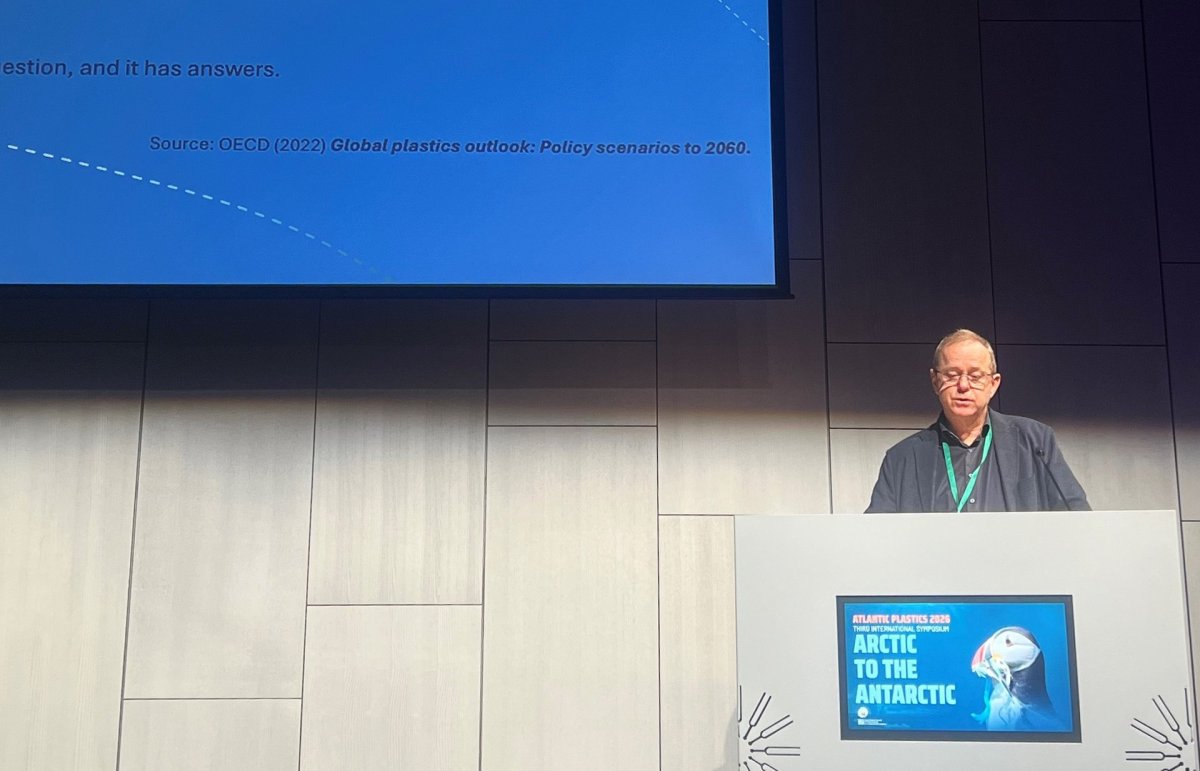
The international symposium Atlantic Plastics 2026 on marine plastic pollution was held at Harpa in Reykjavík on 20–22 October, under the theme Arctic to the Antarctic. It is the third symposium of its kind hosted by the Government of Iceland. It was organized by the Iceland Arctic Cooperation Network (IACN), PAME (the Arctic Council’s Protection of the Arctic Marine Environment working group), UNESCO and the International Council for the Exploration of the Sea (ICES). Staff of the Marine and Freshwater Research Institute (MFRI) took an active part in the symposium, contributing to panels, keynotes and presentations. Among them was Haraldur Arnar Einarsson, fisheries scientist and one of Iceland’s leading experts on fishing gear, who gave a talk at the symposium (photo).
The symposium has some history. A virtual session was held in 2021 and an in-person symposium in Reykjavík in 2023. While the earlier events focused mainly on the Arctic, this year the scope was extended to a global reach.
The symposium addressed the sources, monitoring and modelling of marine litter. Monitoring of beach litter and of macro-, micro- and nanoplastics has increased significantly over the past decade, helping scientists understand the scale and impact of marine plastic pollution. The next step is to build on this knowledge with policies and measures that can effectively reduce plastic pollution in the marine environment.