- EU projects
- Research
- Fish tagging
- Lumpfish research
- Oceanography
- Seabed mapping
- Arnarfjörður
- Drekasvæði
- Ísafjarðardjúp
- Jökulbanki
- Jökuldjúp
- Kolbeinseyjarhryggur and adjacent area
- Kolluáll
- Langanesgrunn
- Látragrunn
- Nesdjúp
- Reykjaneshryggur and adjacent area
- Selvogsbanki
- South of Selvogsbanki
- South of Skeiðarárdjúp
- South of Skerjadjúp
- Southeast of Lónsdjúp
- Southwest of Jökuldjúp
- Suðausturmið
- Suðurdjúp
- Vesturdjúp
- East of Reykjaneshryggur
- Vestfjardarmid
- Seal research
- Whale Research
- Advice
- About

Ecological competition between fin whales, blue whales and their hybrids.
20. October 2026
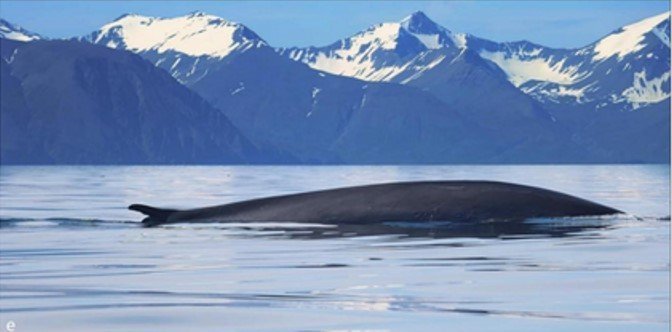 A hybrid between a blue whale and a fin whale.
Photo: Gentle Giants, N-Iceland.
Hybridization among cetaceans has been documented across multiple species, but the question on the ecological position of hybrids has not been answered yet. Within the Balaenopteridae family, most documented cases involve blue and fin whales, raising concerns about impacts on species recovery, particularly that of the highly endangered blue whale. In a recent scientific paper, scientist from our institute, in collaboration with University of Barcelona examined baleen morphology, migratory phenology, distribution, and stable isotope profiles along baleen plates of five fin whales, two blue whales, and three hybrids sampled in Icelandic waters to evaluate ecological overlap among parental species and their hybrids.
Reading the baleen
For this, they use stable isotope ratio of Nitrogen (δ15N), Carbon (δ13C) and Sulfur (δ34S). δ15N values increase with prey trophic level and are therefore widely used as proxies of trophic position. δ13C values exhibit weaker trophic enrichment and are mainly interpreted as indicators of foraging habitat and primary carbon sources, typically higher in coastal than in offshore environments and reflecting broader latitudinal gradients in marine ecosystems, with more 13C-depleted values generally occurring at higher latitudes. Sulfur stable isotope ratios (δ34S) provide complementary ecological information as open-ocean environments generally exhibit homogeneous and relatively high δ34S values due to extensive water mass mixing, whereas coastal and benthic systems often show lower and more variable δ34S values linked to local sulfur cycling processes.
Hybrids lean towards blue
The results indicated that both fin and blue whales relied primarily on krill, resulting in substantial trophic overlap, although fin whales tended to exhibit higher δ15N values consistent with the occasional use of higher-trophic prey. Although the overlap of hybrids in both diet and habitat use occurred with both parental species, hybrids more closely resembled blue whales, possibly due to cultural transmission through the maternal lineage, as most of them have blue whale mothers.
What it means for blue whales
Although differences in habitat use or migratory behavior may reduce direct ecological competition, the substantial trophic overlap observed between blue and fin whales may favor hybridization and potentially contribute to reduced blue whale reproductive output, with implications for the recovery of this species.
The article was published in Marine Mammal Science and can be found here.
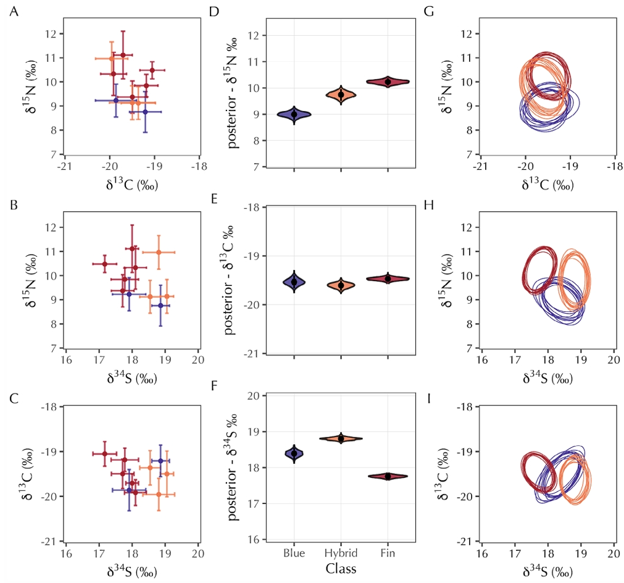
Figure: Isotopic niche structure of blue whales (blue), fin whales (red) and hybrids (orange), based on δ15N, δ13C, and δ34S values. (A–C) Biplots of individual means (±SD) for each pairwise isotope combination. (D–F) Posterior distributions of species- level means and 95% credible intervals for each isotope. (G–I) Posterior ellipses (40% probability region) representing isotopic niches in 2D.