- EU projects
- Research
- Fish tagging
- Lumpfish research
- Oceanography
- Seabed mapping
- Arnarfjörður
- Drekasvæði
- Ísafjarðardjúp
- Jökulbanki
- Jökuldjúp
- Kolbeinseyjarhryggur and adjacent area
- Kolluáll
- Langanesgrunn
- Látragrunn
- Nesdjúp
- Reykjaneshryggur and adjacent area
- Selvogsbanki
- South of Selvogsbanki
- South of Skeiðarárdjúp
- South of Skerjadjúp
- Southeast of Lónsdjúp
- Southwest of Jökuldjúp
- Suðausturmið
- Suðurdjúp
- Vesturdjúp
- East of Reykjaneshryggur
- Vestfjardarmid
- Seal research
- Whale Research
- Advice
- About

Results from the mackerel survey
27. August 2026
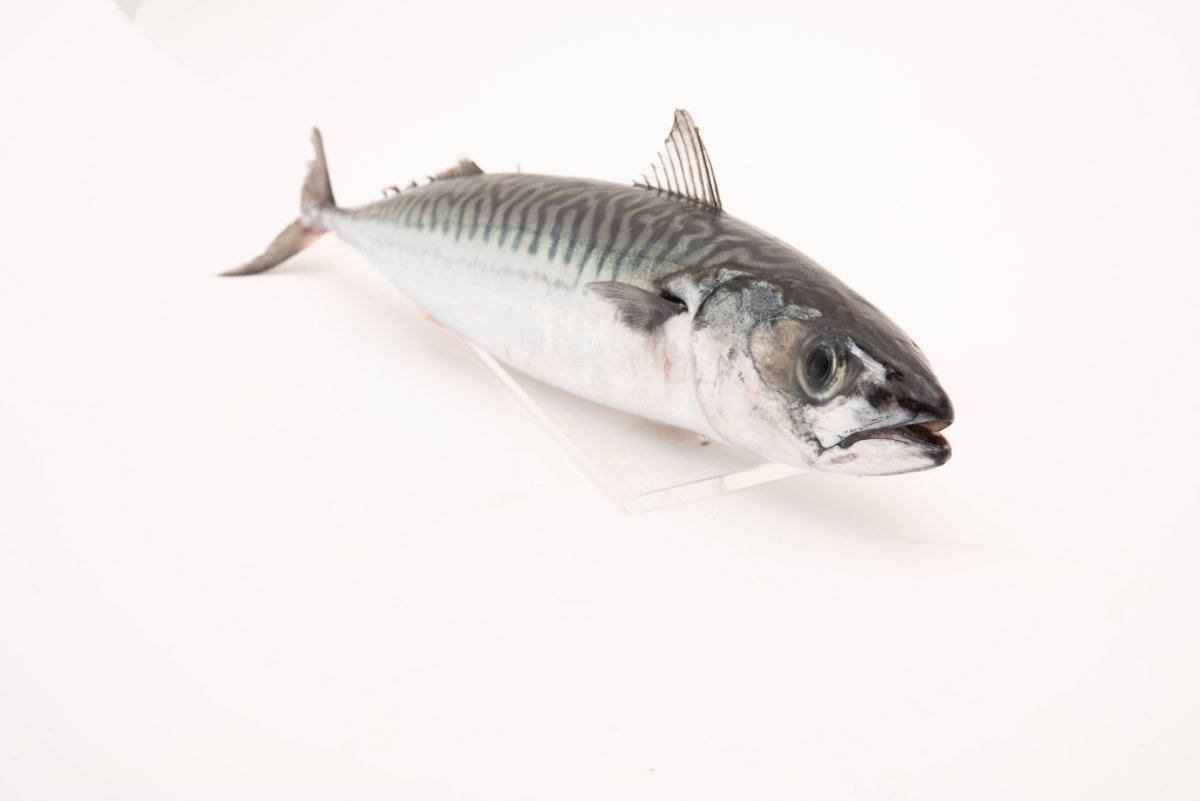 Mackerel. Photo: Svanhildur Egilsdóttir.
Results are now available from a joint pelagic survey conducted by Iceland, the Faroe Islands, Norway, and Denmark between June 29 and July 30, 2026. The primary goal of this annual expedition was to assess pelagic fish stocks in the Northeast Atlantic during summer, while also monitoring the marine ecosystem and ocean environment.
The survey covered 2.2 million square kilometers—nearly 6% smaller than last year. This reduced coverage west of Iceland and in the northern Norwegian Sea was due to a shrinking mackerel distribution.
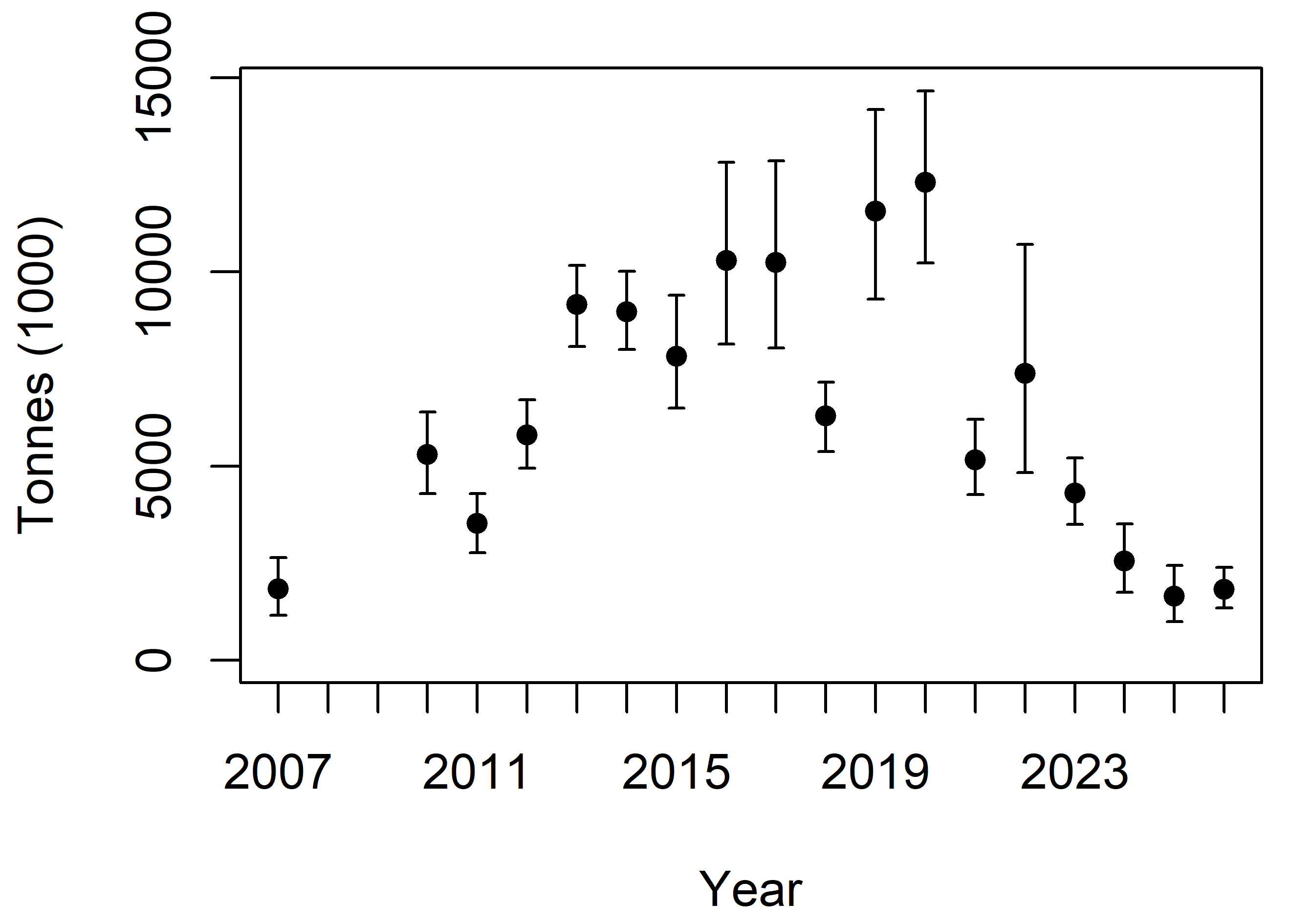
Figure 1. Mackerel biomass index for 2007 and annually from 2010 to 2026. The index includes uncertainty margins (black filled circles show 90% confidence intervals, represented by the vertical lines). Note: The 2011 biomass index is not considered valid because no measurements were taken in the northern Norwegian Sea that year.
Slight Increase in Mackerel Index
The estimated biomass index came to 1.80 million tonnes, representing a 9% increase over 2025 (which had recorded the lowest biomass since 2007). This figure is based on catch samples from 215 standardized surface trawls at predetermined locations. Mackerel aged 2–7 years, as well as those 12 and older, made up the largest shares—each group contributing 10–15% to the total biomass.
Around Iceland, mackerel distribution remained similar to last year with slightly higher density, peaking east of the country. No mackerel was detected off the west or south coasts (continuing a trend seen since summer 2023). Most of the stock remained in the Norwegian Sea—concentrated in the southeast—and in the northern North Sea, shifting away from historical patterns.
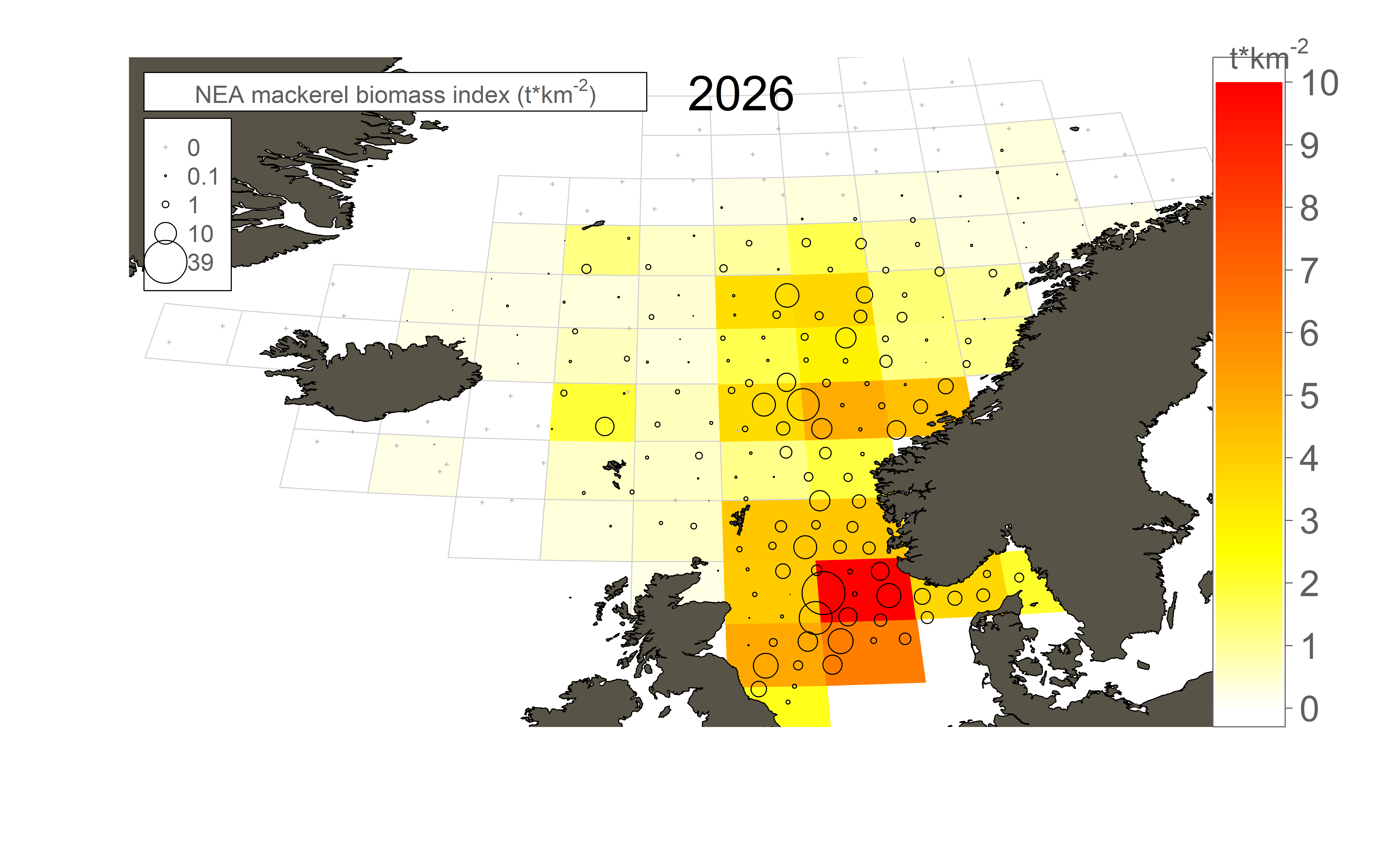
Figure 2. Mackerel distribution shown as density index calculated by grid squares (2° latitude by 4° longitude) for June and July 2026, where white squares represents that no mackerel was detected, color scale (Yellow to Red) indicates increasing density measured in tonnes per square kilometer, circle size represents the total mackerel catch at individual trawl stations (tonnes per square kilometer), and small gray crosses indicate trawl stations where no mackerel was caught.
Other Key Findings
Acoustic measurements of blue whtining set the biomass index at nearly 2.8 million tonnes (up almost 14% from 2025), driven mainly by 1- and 2-year-old fish (35% and 22% of biomass, respectively).
Acoustic measurements put the Norwegian spring-spawning herring biomass index at nearly 5.9 million tonnes—over 28% higher than last year. The 2021 and 2016 year-classes (5- and 10-year-olds) dominated, each accounting for roughly 28% of total biomass.
Satellite data showed July surface temperatures east, south, and west of Iceland were cooler than last July, yet still above the 20-year average. Surface waters northwest of Iceland fell below the 20-year average, whereas the Norwegian Sea was above average and coastal Norway was below average.
Zooplankton levels around Iceland in July were slightly lower than last summer. Levels increased slightly in the Norwegian Sea, matching its long-term average since 2010.
Next Steps
The survey's mackerel findings were presented to the International Council for the Exploration of the Sea (ICES) working group this week. Alongside other data, these results will be used as input data for stock size estimation and for providing advice on fishing opportunities. ICES plans to publish its official catch advice for mackerel, Norwegian spring-spawning herring, and blue whiting for the year 2027 on 30 September .
Skýrslu um bráðabirgðaniðurstöður leiðangursins má nálgast hér.