- EU projects
- Research
- Fish tagging
- Lumpfish research
- Oceanography
- Seabed mapping
- Arnarfjörður
- Drekasvæði
- Ísafjarðardjúp
- Jökulbanki
- Jökuldjúp
- Kolbeinseyjarhryggur and adjacent area
- Kolluáll
- Langanesgrunn
- Látragrunn
- Nesdjúp
- Reykjaneshryggur and adjacent area
- Selvogsbanki
- South of Selvogsbanki
- South of Skeiðarárdjúp
- South of Skerjadjúp
- Southeast of Lónsdjúp
- Southwest of Jökuldjúp
- Suðausturmið
- Suðurdjúp
- Vesturdjúp
- East of Reykjaneshryggur
- Vestfjardarmid
- Seal research
- Whale Research
- Advice
- About

Capelin ALERT!
08. January 2026
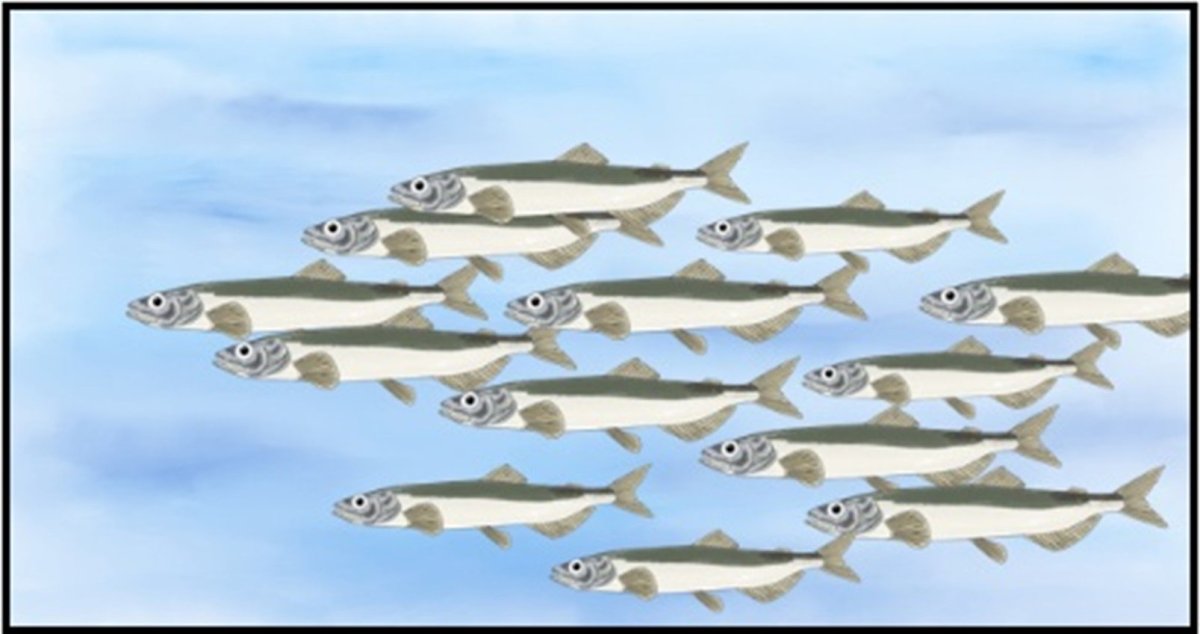
The Marine and Freshwater Research Institute has initiated the publication of a special issue on capelin Mallotus villosus (Müller, 1776) in the scientific journal „Reviews in Fish Biology and Fisheries“. The special issue is titled „Capelin in a changing environment“ and contains a total of 16 journal articles covering diverse aspects of capelin biology and ecology across the four major capelin stocks in the Subarctic namely the Iceland-East Greenland-Jan Mayen (IEGJM), Barents Sea, Newfoundland and Labrador Shelf and Alaska. Most of the studies reveal decadal trends in capelin distribution and abundance demonstrating changes in migration and behavioural patterns relevant for fisheries management. They also highlight basic information on stock structure and variation in life-history traits.
Scientists at MFRI active in Capelin Research
Scientists at MFRI are first authors on seven articles in this special issue, mainly originating from the findings of the capelin research study conducted from 2018-2022, see here. In the last two decades, the Icelandic-East Greenland-Jan Mayen stock has exhibited both intense variation in biomass and large-scale shift in distribution. The research documents the effect of this shift on the life history traits (Singh et al., 2025a), provides updated information on the distribution and density of larvae (dos Santos et al., 2025), and diet composition at the new feeding grounds along East Greenland (Petursdottir et al., 2025).
It also provides information on the influence of capelin vertical migration on acoustic measurements of biomass (Silva et al., 2025), and the characterisation of habitats in relation to hydrographic condition and location of feeding areas (Singh et al., 2026).
Finally, a perspective paper synthesizes our current knowledge and outlines the strategic development needed for the implementation of an ecosystem approach to fisheries management for capelin (Singh et al., 2025b).
In addition, a scientist at MFRI is contributing author on Rodriguez-Tress et al. (2026) paper, which examines density-dependent capelin aggregations during the feeding period off East Greenland.
Below are the eight contributions from the MFRI to the special issue:
dos Santos Schmidt TC, Kennedy J, Jónsson SÞ, Óskarsson GJ (2025) Distribution and density of larval capelin (Mallotus villosus) around Iceland and associated environmental conditions. Rev Fish Biol Fisheries 35:1101–1117. https://doi.org/10.1007/s11160-025-09946-7
Pampoulie C, Davoren G, Garrido S, MacKenzie B and Slotte A (2026) Capelin: A key Arctic species on the move. Rev Fish Biol Fisheries 36:23. (Editorial). https://doi.org/10.1007/s11160-025-10032-1
Petursdottir H, Jansen T, Silva T, Jónsson SÞ, Bárðarson B, Singh W (2026) Diet composition and feeding behavior of capelin (Mallotus villosus) in the changing Iceland–East Greenland–Jan Mayen ecosystem. Rev Fish Biol Fisheries 36:3. https://doi.org/10.1007/s11160-025-10022-3
Rodriguez-Tress P, Jansen T, Jónsson SÞ, Neuenfeldt S (2026) Density-dependent aggregation patterns in a small pelagic fish species: the East Greenland capelin. Rev Fish Biol Fisheries 36:12. https://doi.org/10.1007/s11160-025-10014-3
Silva T, Jónsson SÞ, dos Santos Schmidt TC, Bárðarson B, Singh W (2025) Influence of diel vertical distribution and physiology on capelin (Mallotus villosus) target strength measurements. Rev Fish Biol Fisheries 35:1935–1952 https://doi.org/10.1007/s11160-025-09987-y
Singh W, Bjarnason S, Pampoulie C (2025a) Has the displacement of the capelin Mallotus villosus (Müller, 1776) feeding grounds induced a phenotypic response? Rev Fish Biol Fisheries 35:875–892. https://doi.org/10.1007/s11160-025-09937-8
Singh W, Trochta JT, Murphy HM, et al (2025b) Small fish, big implications: considerations for an ecosystem approach to capelin fisheries management. Rev Fish Biol Fisheries 35:1899–1934. https://doi.org/10.1007/s11160-025-09986-z
Singh W, Giorgi E, Jónsson SÞ, Silva T, Våge K (2026) Habitat characterization of capelin along East Greenland: insights from hydrographic conditions and feeding distribution patterns. Rev Fish Biol Fisheries 36:7. https://doi.org/10.1007/s11160-025-10019-y
The special issue can be seen here.