- EU projects
- Research
- Fish tagging
- Lumpfish research
- Oceanography
- Seabed mapping
- Arnarfjörður
- Drekasvæði
- Ísafjarðardjúp
- Jökulbanki
- Jökuldjúp
- Kolbeinseyjarhryggur and adjacent area
- Kolluáll
- Langanesgrunn
- Látragrunn
- Nesdjúp
- Reykjaneshryggur and adjacent area
- Selvogsbanki
- South of Selvogsbanki
- South of Skeiðarárdjúp
- South of Skerjadjúp
- Southeast of Lónsdjúp
- Southwest of Jökuldjúp
- Suðausturmið
- Suðurdjúp
- Vesturdjúp
- East of Reykjaneshryggur
- Vestfjardarmid
- Seal research
- Whale Research
- Advice
- About

New research on hybrids between blue and fin whale
08. June 2026
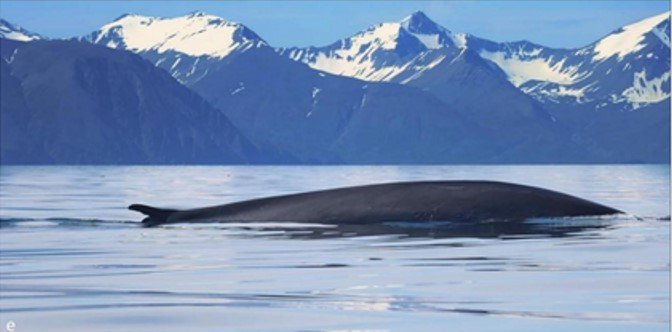 A well- known male hybrid swimming in the water North of Skjálfandi bay in Iceland since 2012.
Scientists at MFRI recently published a review paper on the occurrence of hybrids between blue (Balaenoptera musculus) and fin (B. physalus) whales in the world. Hybrids between blue and fin whales have been reported from commercial whaling since the late 1800s. At that time, whalers very often described whales exhibiting intermediate morphological characteristics between blue and fin whales.
In recent decades, these morphological atypical whales were confirmed genetically to be hybrids between both species. The review paper titled “What Do We Know About Hybrid Blue (Balaenoptera musculus) and Fin (B. physalus) Whales? A Comprehensive Review Across Ocean Basins” summarizes the current knowledge on the occurrence of hybrids between both species across ocean basins. To date, a total of 46 possible hybrids were reported among which 17 were genetically confirmed: 15 from the North Atlantic, one from the Mediterranean Sea and one from the north-east Pacific.
Genetic analyses tend to suggest that most of the time the mother of the hybrids is a blue whale and the father a fin whale. The authors mentioned that the literature on the potential causes of hybridization among cetaceans, and especially blue and fin whales, remains limited. However, suggestions have been made that cetacean species have a high probability of producing hybrids when morphological and behavioural traits such as vocalisation frequency and body size were similar between the two potential parental species. The authors also stated that regardless of the mechanism, hybridization between blue and fin whales has been proven to persist for over two centuries and has likely influenced the genomic architecture of both species. They recommend collecting biopsy samples of whales exhibiting atypical morphological traits in order to better evaluate the impact of hybridization on both species.
The article can be found here.
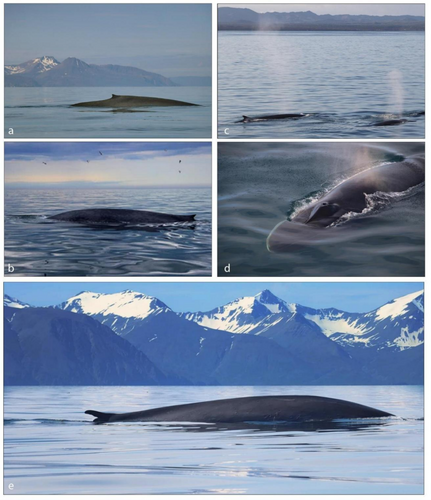
Blue whale (a, b), fin whale (c, d) and a hybrid (e) in Icelandic waters. Pictures were kindly provided by Gentle Giants, Húsavík (a, b, e; website: https://www. gentlegiants. is) and Special Tours Iceland (c, d; website: https://specialtours.is). (e) The well- known hybrid swimming in the water North of Skjálfandi bay in Iceland since 2012 is a male hybrid, resulting from the successful mating of a female blue whale and a male fin whale. It is usually seen within a group of blue whales.